
|
Getting your Trinity Audio player ready...
|
Reading Time 8 mins
July 26, 2025
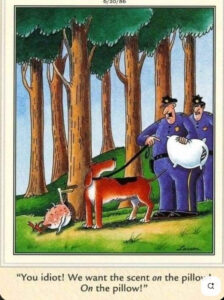 Cartoon by Gary Larson
Some people like knock-knock jokes. My younger daughter’s mother likes elephant jokes and other people like cat videos. I like duck jokes, although I don’t know many, perhaps because I don’t play cricket. In fact, I only know one duck joke, which has to do with a ten-inch pianist, a genie hard of hearing and a million ducks – too long and convoluted to tell here. Also too corny. However, I think I can say that Gary Larson shares my taste for duck humour. One of his cartoons that I still recall years after encountering it has a diverse gang of animals speeding down the highway in an open-top sports car. Maybe a duck flies high above. As they race towards a low overhead pass, about to go under, the driver (is it a dog? I can’t recall), yells a warning to his passengers: “Duck!”
The giraffe in the back seat stretches up to peer into the sky: “Where?”
Another of Larson’s cartoons coined the term Anatidaephobia: “The fear that somewhere, somehow, a duck is watching you.” Some people took it for a bona fide mental condition, although a few websites present it as a general “fear of ducks” that is a sub-set of a very real phobia, ornithophobia, which is the fear of birds that was significantly increased by Alfred Hitchcock.
Larson, a committed environmentalist, may not actually prefer ducks; all animals are fodder for his sideways take on the conviction that we are superior to other species. Ducks only entered my mind because I recently spent time in the US and saw them everywhere. I marvelled how, like other migrating birds, their sense of direction allowed them to navigate considerable distances without google maps, whereas throughout my stay in mostly Boston I experienced an unsettling geographic disorientation. I couldn’t for the life of me develop any awareness of which direction I was heading, where was the way to the metro station or the supermarket, or any of the other places I visited regularly. I was accompanied hither and thither to the same places to which I couldn’t navigate alone without GPS, and even then would I’m sure would have taken many wrong turns.
I studied maps in an attempt to internalise the cardinal points, but remained lost and longing perhaps for the special sense of spatial intelligence other people possess that makes them at home everywhere. I sought consolation in the words of the German poet and philosopher Novalis. “Philosophy is home-sickness, the desire to be at home everywhere,” he said. And since we desire what we lack, I extrapolated: to be philosophical must be home-sick, i.e. lost, even at home. What if, I thought, I could share my geographic disorientation and so make my sometimes thoughtless people a little more philosophical?
The first world maps were made by Europeans after Columbus’ voyages, and they generally placed Europe in the North, the one exception being French cartographer Oronce Fine (1494-1555). However, once the flemish cartographer Gerardus Mercator drew his 1569 world map, all others were and have ever since positioned North above South, which meant that Europe was above Africa and Asia.
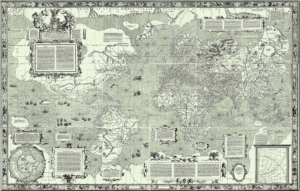 Nova et Aucta Orbis Terrae Descriptio ad Usum Navigantium Emendate Accommodata, 1569 (Renaissance Latin for “New and more complete representation of the terrestrial globe properly adapted for use in navigation”) by Gerardus Mercator
Most modern maps, which are based on the Mercator projection, are hopelessly inaccurate and misleading about the relative sizes of different countries and continents, presenting North America and Europe as far larger than they really are. Brazil, for instance, is bigger than Australia, almost the same as the US or Europe but much smaller than Africa. Indeed, a more accurate projection presented by Arno Peters in 1974 shows an Africa that can contain the USA within its shores alongside China, Western Europe, India, Argentina, Scandinavia and the UK all at once with elbow room to spare. That map ignited a decades-long ideological controversy in the world of cartography. Supporters cheered its removal of European biases, while critics pointing out that Peters’ projection wasn’t revolutionary at all but rather was similar to the 1855 map by James Gall, nyeh nyeh, and besides, by being more topographically accurate it made countries look distorted and unrecognizable.
Conservative cartographers also claimed that spreading a spherical shape on to a flat, two-dimensional page is bound to introduce some distortions. Lines of longitude that meet at the poles are presented as parallel lines up and down the map, which expands the North and South zones relative to the tropics. I’d bet, however, that European mapmakers would never have accepted the distortion if it made their homelands look smaller than Africa or India. The result was that nothing changed except UNESCO and some NGOs adopted Peters’ world map as a step to decolonizing geography.
There’s one equally valid change that no one, not even the most liberal cartographers would dream of: that is place the Southern hemisphere up above and Northern one down below. No one would consider drawing the Third World above Europe and the USA. Why not? When it comes to cosmic directions there’s no up and down or above and below in the directionless void through which our pale blue dot whirls like a dizzy Dervish. Outer space is spatially neutral. Up and down there are as non-sensical as left and right, or even, as Einstein showed, forwards and backwards, or fast and slow. Indeed, despite the insistence of many courses on the development of civilization, on a sphere there’s no East and West. Carl Sagan in his beautiful essay Pale Blue Dot points out that “astronomy is a humbling and character-building experience. There is perhaps no better demonstration of the folly of human conceits than this distant image of our tiny world.”
Because above is psychologically good, and below is bad. Because historically most world maps were drawn by white people who placed themselves then as they do today, above all other people. In their overweening sense of sueriority they projected themselves above Africa, Asia and South America.
Cartographers drew Europe and the USA in the upper hemisphere and continue to do so solely because white people have politically, militarily and economically dominated and exploited their neighbours to their south. That is, they have been metaphorically above southern peoples. George Lakoff and Mark Johnson in their influential study of Metaphors We Live By (1980) explain, for instance, how up-down metaphors derive from life itself. They are not talking about the fancy and flowery “metaphors” used by poets and their like, but everyday words with which we conceptualise reality, words which in turn affect how we look at emotions, awareness, health, authority, quantities, social status, virtue and other things like, I might add, maps that place Europe and North America above southern countries. In that case I am referring to the metaphoric concepts of up and down, whose resonances are (to paraphrase Lakoff and Johnson) as follows:
HAPPY IS UP; SAD IS DOWN – I’m feeling up. Something boosted my spirits, which rose, so I’m in high spirits. Thinking about her always gives me a lift when I’m feeling down, I’m depressed and really low. I fell into a depression and my spirits sank.
CONSCIOUS IS UP; UNCONSCIOUS IS DOWN – Get up, wake up, I’m up already. I rise early… He fell asleep. He dropped off to sleep under hypnosis. He sank into a coma.
HEALTH AND LIFE ARE UP; SICKNESS AND DEATH ARE DOWN – He’s at the peak of health. Lazarus rose from the dead. He’s in top shape. His health is way up there. Then he fell ill. He’s sinking fast. He came down with Covid. His health is declining. He dropped dead.
HAVING CONTROL OR POWER IS UP; BEING SUBJECT TO CONTROL IS DOWN – I have control over her. I am on top of the situation, in a superior position and at the height of my power. I’m in the high command, the upper echelon. My power rose. I rank above him. He’s under my thumb after he fell from power. His power declined. He’s my social inferior, a low man on the totem pole. Get up, stand up, stand up for your rights!
MORE IS UP; LESS IS DOWN – The number of boring books printed each year keeps going up, and the number is high. My income rose last year. The artistic activity here has gone down. The number of errors he made is incredibly low. My income fell last year. He is underage. If it’s too hot, turn the heat down.
HIGH STATUS IS UP; LOW STATUS IS DOWN – He has a lofty position but she’ll rise to the top. He’s at the peak of his career and climbing the ladder. She has little upward mobility, is at the bottom of the social hierarchy. She fell in status.
GOOD IS UP; BAD IS DOWN – Things are looking up. We hit a peak last. year, but it’s been downhill ever since. Things are at an all-time low. He does high-quality work.
VIRTUE IS UP; DEPRAVITY IS DOWN – She is high-minded, has high standards and is upright, an upstanding citizen. His was a low dodge. Don’t be underhanded. I wouldn’t stoop to that. It would be beneath me. He fell into the abyss of depravity. That was a low-down thing to do.
RATIONAL IS UP; EMOTIONAL IS DOWN – The discussion quickly descended to emotional outbursts, but I elevated it back to a rational discourse. We put our feelings aside and had a high-level intellectual discussion. He couldn’t rise above his emotions, however. Even Rastafarians realize that it’s better to overstand than understand.
Up feels good, healthy and so forth, while down is the opposite for several reasons. Droopiness conveys sadness, whereas an erect posture suggests a positive emotional state. That’s why willows and detumescent men weep. Humans and most other mammals sleep lying down and stand when awake. Serious illness forces you to lie down, especially when you’re dead. Size typically correlates with physical strength, and the victor in a fight is typically on top while the loser remains down for the count. As you add more of a substance or physical objects to a container or pile, the level rises. Since status is correlated with (social) and (physical) power: more, or a higher level of it, is better.
Those ideas come from our existential condition. Thinking emerges from how we inhabit our living bodies, which is abused in Cartesian cartography. There’s no rational reason why people living in the North should be up (happy, conscious, healthy, controlling, higher and better) and the South down (unhappy, unconscious, unhealthy, controlled, lower, worse, etc.). Up and down have to do with gravity, up being further from the centre of the earth, and down closer to it, wherever on the globe you find yourself. Up and down, above and below are physically irrelevant to North and South. Australians, South Africans, Patagonians and the Antartican penguins don’t really walk upside down.
When in 1972 the crew of Apollo 17 took a photo of the earth entitled “Blue Marble”, showing the South Pole at the top of the planet, Nasa couldn’t bear the idea of making that idea public. Before releasing the image the agency rotated it 180 degrees to place the South below the North. It was unthinkable to challenge North America’s being metaphorically above the South, a dominance that’s caused much of the suffering that Carl Sagan described as “the endless cruelties visited by the inhabitants of one corner of this pixel on the scarcely distinguishable inhabitants of some other corner, how frequent their misunderstandings, how eager they are to kill one another, how fervent their hatreds.”
We’ll never change things until we change how people think. From now on I recommend that North should no longer be up and South down; Europe, the US and Canada should not be positioned on maps above South America, Africa and Asia. No longer should a disastrous project be described as one that “went South”.
And since I’m an equatorial man, Trinidad being a mere ten to eleven degrees away from the planet’s lop-sided midriff, I similarly find no reason to turn things upside-down. I don’t subscribe to any biblical first shall be last and last first, so you won’t find me simply situating South up top and the North down below. Such a lie of the land would still leave huge equatorial countries smaller than tiny temperate ones. Accordingly, I shall henceforth look at the world neither up nor down, neither topsy nor turvy, but sideways as the crab scurries.
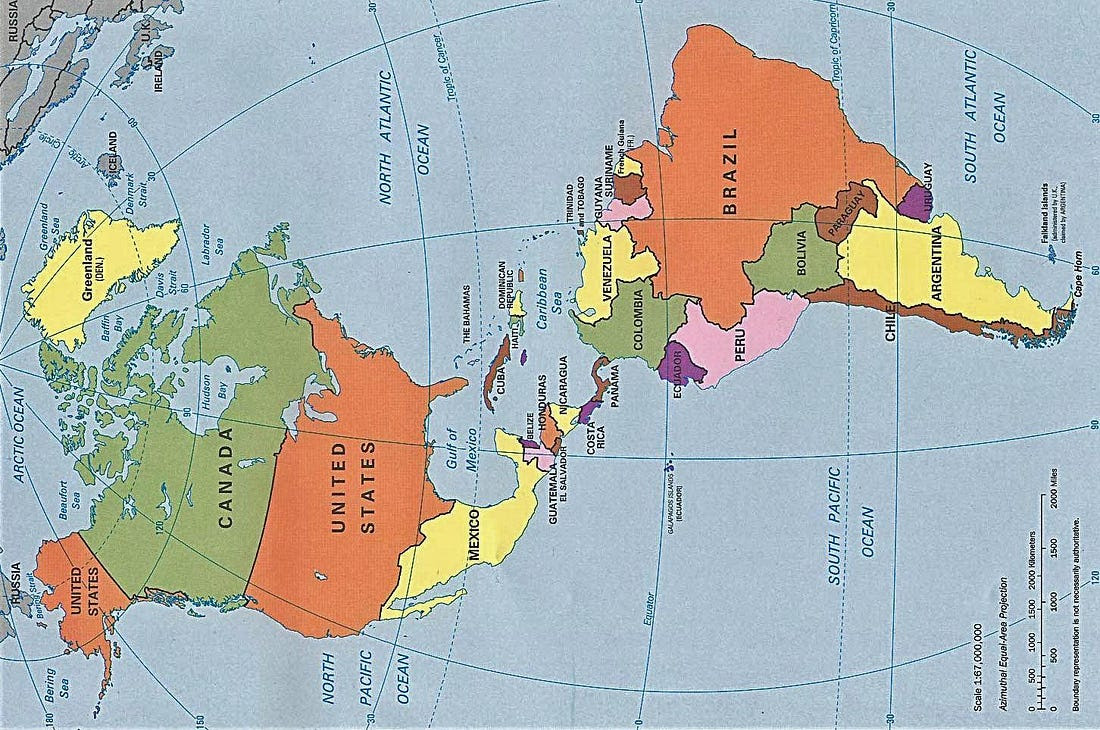
Now tell me: don’t that look like a duck?
 Kim Johnson is a filmmaker and writer.