
|
Getting your Trinity Audio player ready...
|
Reading Time 4 mins
GOUYAVE’S MELROSE HOUSE
By Caldwell Taylor
“Imbued with the message from the past, the historic monuments of generations of people remain to the present day as living witnesses of their age-old traditions.”
— From a statement adopted by ICOMOS in 1965. ICOMOS is the International Council on Monuments and Sites.
A Living Witness to Gouyave’s History
The iconic building is an unmistakable repository of Gouyaveniss. Indeed, this explains why skirls of protest have arisen from many who argue that the demolition of this fine emblem of Caribbean vernacular domestic architecture will gravely diminish Gouyave’s built distinctiveness and civic sensibilities, while scarring both its streetscape and its collective psyche.
But should this, or for that matter any other old building, stand in the way of change? And what good is the past, anyway?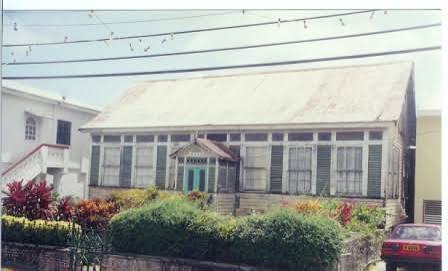
What Is the Past Good For?
The past locates us in place and time, at once giving us perch, perspective, and identity. The past is usable and, as historian Margaret MacMillan points out, it can school us in the virtues of humility and skepticism, two very important hedges against the wild dreams to which we are so often prone.
Preserving the past means preserving memory.
Jacob Burckhardt (1818-1897), the Swiss historian and father of cultural history, understood this in the nineteenth century. Burckhardt’s historical method is neatly summarized in the following observation:
“And all things are sources, not only books, but the whole of life and every kind of spiritual manifestation.”
The explanatory and instrumental value of the past also seemed evident to William Morris (1834-1896), the British “Poet Laureate of Socialism” and founder of the Society for the Protection of Ancient Buildings in 1877.
Morris’s vision informed the enactment of Britain’s Ancient Monuments Protection Act in 1882 and inspired the creation of the National Trust for Places of Historic Interest or National Beauty in 1895. His Promethean vision was also implicated in the making of the 1931 Athens Charter and its progenies, all of which seek to imbue us with messages from the past.
Stories Embedded in Stone and Wood
Melrose House is planted in our past, and its sea-sprayed shadow hobbles across an indifferent present.
Being an old building means that Melrose is inhabited by countless stories, stories about the person or persons who commissioned it, dwelled beneath its roof, labored within its walls, and countless others. Standing before this shuttered mansion, an awed visitor feels compelled to inquire into its exact age, the many influences etched into its façade, and, finally, the possible origin of its aristocratic name.
That final question transports the visitor to the battlefields of the Second Boer War, where the Boers of Transvaal and Orange Free State fought the British from 1899 until 1902.
Lord Roberts, and later Horatio Kitchener, directed British military campaigns while operating from the war room of Pretoria’s Melrose House. It is also worth recalling that the Boer War officially ended with the signing of the Treaty of Vereeniging at Melrose House in Pretoria on May 31, 1902.
From South Africa to the Caribbean Imagination
The Second Boer War expanded the geographic knowledge of the people of the British West Indies.
Military dispatches arrived from Kimberly, Ladysmith, Melrose House, and Majuba Hill, places that soon became embedded within the consciousness of a colonized people and stood as symbols of the perceived impregnability of Britain.
In the wake of the war, the owner of a Gouyave mansion could easily have named his residence Melrose House, just as a platoon of badjohns in neighboring Trinidad adopted the name “Majuba Boers,” while their territory became known as “Majuba Hill.”
During the years of the Boer War, the Majuba Boers danced to calypsos that brought the exploits of imperial soldiers home to Trinidad.
Significantly, the word “calipso” (sic), meaning a topical Trinidadian song, appeared in print for the first time on January 20, 1900, in the pages of the Port of Spain Gazette. The term introduced a collection of Carnival songs, one of which commented on the war then dominating public attention.
Climbing up, climbing up Majuba hill,
We are all a contingent and foreman calypso
Tell the people for me we coming up sans Humanite
We coming up, we make up we mind to sing
The double tone, faire you devirai (make them come back again)
The composition, written by Henry Julian, calipso’s “Iron Duke,” received the 1900 “Song of the Year” award.
A Fading Beauty
More than one hundred years later, Gouyave’s Melrose House continues to look out onto Central Depradine Street through its stiff jalousie louvres.
She is a fading beauty who returns a visitor’s gaze with the hauteur of the plantation plutocrat.
How many secrets are sequestered within her bosom? How many anguished cries continue to peel from her flaky walls, and for how much longer?
Her time is drawing near.
Her last rites have been intoned and the executioner’s hammer has been hoisted. It will soon fall, and this historic building will give way.
Not very many tears will be shed, for in these parts the past is often seen as merely the unremarkable path to an inconsequential present.