|
Getting your Trinity Audio player ready...
|
Reading Time 7 mins
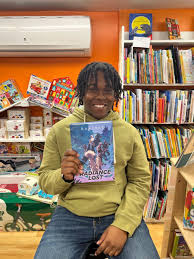
 Hello everyone! For anyone who may not be familiar with me, my name is Raafeke, and I am cultural writer highly interested in the traditions and practices found throughout the African diaspora. I have been writing for as long as I can remember, as I have aged, my interest in the traditions of today, as well as those of the past, have continued to fuel my work. I was in Brooklyn and raised between Bedstuy and the suburbs of Atlanta. Despite my prolonged period of time in the South, I was reared by the thick culture of my Guyanese father and Grenadian-American mother. Home, as a result, existed in a revolving door between my physical shelter in metro-Atlanta, New York City, and the West Indies.
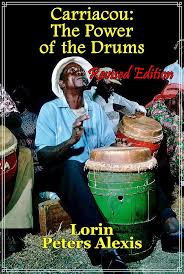
In the last four years, my literary work has been extremely focused on the African histories and legacies within the Caribbean, particularly Carriacou, the birthplace and home of my maternal grandparents and family. In 2018, I visited for the first and only time, and was lucky enough to spectate our famous Big Drum Dance. Three years would pass between this visit and my conscious decisions to approach this tradition from an academic and spiritual lens. As a result, when I was gifted the book Carriacou: The Power of the Drums, I felt compelled to read it.
Written by Lorin Peters Alexis, a Carriacouan who has been a part of Big Drum Dance celebrations all her life, this 70 page book is one of the most recent publications following Carriacou’s Big Drum Dance. The book starts with a breakdown of Carriacou’s unique position as an island that is geographically a part of the Grenadines (like St. Vincent) but politically and socially connected to Grenada, the larger island after which the entire tri-island state is named. Unlike older books I have read, such as The Big Drum Ritual of Carriacou: Praisesongs in Rememory of Flight, by Lorna McDaniel, Alexis discusses how this socio-religious tradition has connected Carriacouans with others, such as the Temne of Sierra Leone.
Much of my own research on the Big Drum Dance has been primarily focused on how this tradition has connected present-day and deceased Carriacouans with their ancestry. The Big Drum Dance enabled the our enslaved ancestors and those who came after to maintain a great deal of connection to Africa and, to a lesser extent, their spirits. Our ancestral nations are:
- The Kromanti, a term for the Akan and Asante peoples of modern-day Ghana.
- The Hausa, who are primarily located in northern Nigeria.
- The Igbo, who originate in southeast Nigeria.
- Also includes the Scotch-Igbo, highlighting racial mixing between Scottish enslaver and settlers and enslaved Igbo people in the island.
- The Temne, from Sierra Leone.
- The Arada, a term for Fon, Ewe, and Aja peoples of modern-day Benin, Togo, and other parts of West Africa.
- The Kongo, which encompasses groups of people from the ancient Kingdom of Kongo, a nation that stretched from modern-day Angola to the Democratic Republic of Congo.
- The Chamba, an ethnicity found in Nigeria’s northeast and Cameroon’s northwest, not to be confused with the Tchamba of Ghana.
- The Moko, a term used to describe an amalgam of people from a region once known as Moko, 50 miles north of the city of Calabar (modern-day Nigeria). This group is comprised of Ibibio, Efik, Ekoi, and Igbo people.
- The Mandinka, also known as Manding or Malinke. Despite being heavily associated within modern-day Mali and the ancient Malian Kingdom ruled by various Musas (kings), the bulk of their population is actually in Guinea, sometimes referred to as Guinea-Conakry, a country formally colonized by the French.
- The Banda, an ethnicity also originating from central Africa.
Overall, the book lends readers a great amount of detail in the Big Drum Dance’s origins and the significance of the items and protocols followed within. Peters does an excellent job of not only discussing the importance of drumming for Africans prior to, during, and after enslavement, but connects the boula and cutter drums of Carriacou with the famous djembe drums and the traditions associated with them in West Africa. She also includes the reasonings as to why the Big Drum Dance is performed, from funerals, weddings, the construction of houses, a need for rain, and more.
For me, the details around the Saraca, also known as the Tombstone Feast and even Old Parents Plate, was highly enjoyable. The practice of leaving out food for ancestral spirits can be found not only in the African diaspora, but across the world. With the presence of large Afro-Caribbean religions in Haiti, Cuba, and other parts of the Americas, information around ancestral offerings can become generalized and vague. It is here that Alexis experience as a Big Drum practitioner and Carriacouan become invaluable; she is able to provide details about specifically Carriacouan ancestral offerings that, in my experience, could only be found online due to recordings from Alan Lomax’s visit to Carriacou in the 1940s and 1950s, and recent, but more vague accounts.
We feed and nourish our ancestors with the best meats, provisions, rolled coocoo, rolled rice with an egg in the middle, split pea soup, and liquor. After this special treat, we make our supplications or the ancestors. We will ask for prosperity, good luck, protection from evil and from evil spirits, fruitful journeys, the safety of our boats, and a long life. Our good ancestors will stand guard and give us around the clock protection.
It is this quote above that motivates me to continue writing, adhering to, and practicing the spiritual elements of the Big Drum Dance. Even though it has grown into somewhat of a commerical export as Grenada expands its tourism industry, Peters’ following sentiment reemphasizes that this tradition and its beliefs are not empty, even if knowledge on what the Big Drum Dance encompasses is limited between Carriacouans at home and those abroad.
It cannot be overemphasized that this is not just an empty belief. There are stories of sea captains or farmers or families turning their bad luck into prosperity just by making a Saraca.
As I came to the end of the book, I found myself a bit emotional. Not sad, but in awe of the people I belong to and the culture I get to participate in. Peters, Winston Fleary, Lorna McDaniel, and others who have developed a great interest in the Big Drum Dance are connected through several shared understandings; the importance of African history beyond the misinformed legacy that our origin begins when Europeans “discovered us”, and that African religious thought and expression is highly complex and resilient.
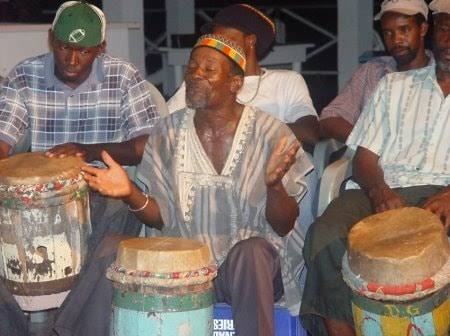
Winston Fleary (1943-2019)
In my opinion, the second statement is often reserved for Yoruba-derived religions found in the hispanophone Caribbean (Cuba, Puerto Rico, and the Dominican Republic) where lighter skin and hypersexualization of Spanish culture has made African religious expression more paletable. While these practices are still stigamtized, the disdain and fear that their counterparts, such as Haitian Vodun and Obeah (a broad term for African faiths in the anglophone Caribbean) elicit in others is seemingly higher. Where these negative feelings are absent, disregard and disbelief fill the void. African traditions are still heavily reduced to mere superstition both in the Caribbean, Latin America, the U.S. and the African continent. This is why literary publications such as Carriacou: The Power of the Drums is important. They calmly state the following: Carriacouans are an intelligent and spiritual people, and we are so because of our African heritage.
When we congregate, the land we stand on becomes the sacred space. When we drum, sing, and dance, we bring life to the dead. When nourish our ancestors, we nourish ourselves. Remembering our past through culture and faith roots us in who we are and grounds us in the unknown of the future, no matter the coming challenges. We are resilient by practicing resilience, and it is this that also makes us gentle.
Of course, no book is perfect, especially when a writer is tasked with transcribing a physical and emotional tradition into words. All languages have limitations to what they can capture. In the case of the Big Drum Dance, complexity is heightened due to the generally inability for Carriacouans to understand the songs being sung word-for-word due to their existence in Grenadian Patois, a french-based creole with more in common to Haitian Kreyol (as well as Dominican, St. Lucian, and the other francophone islands) instead of Jamaica, despite the same use of the word patois.
To work around this, I have been learning Haitian Kreyol alongside other Caribbean variants for nearly two years. This in turn, has helped me identify routine errors that seem to reoccur in the transcription of the Big Drum Dance song lyrics, especially within the Nation songs. These songs are the oldest ones in the tradition, and generally use African languages and Patois.
The lyrics for Cromanti Cudjoe, as an example seem nearly unintelligible, but I have come to realize that, after his name and the names of other ancestral spirits are called, the chantwell (singer) is likely saying some variant of the word Dahomey. To be clear, this is not a fact, but it is my own hypothesis. Peters herself writes the lyrics as “Cromanti Cudjoe! Ah, dawu le! Dawu le mama.” The word dawu does not exist in Caribbean French-creole languages, and le means “when”. If these lyrics are correct, they do not make sense. Dahomey serves a stronger stand-in, even though Cromanti Cudjoe would not come from this area. It is a fact that many enslaved Africans were taken from Dahomey and brought to various parts of the Caribbean, making me hypothesize that Dahomey served as a place of origin within the tradition when it was far more religious, similar to the concept of Ginen in Haitian Voudou.
The lyrics could also be “Cromanti Cudjoe, pa boule!” meaning, “Cromanti Cudjoe, don’t burn!” but that is also speculation on my part. As I said before, Grenadian Patois is a nearly extinct language in all three islands, and a concerted effort to revive it would also strengthen the tradition against further erosion.
For anyone interested in the Big Drum Dance, I really encourage you to read this book. To Ms. Alexis, if you see this, thank you for your work. You have reminded me even when we feel alone in our interests and passions, there is always someone out there walking your same path.
Bon zanset nou ka veye ou! Onoree ou ban ye ka retounen pou ou ak ban ou anpil bon bagay. Tan ak we. Viv la gen anpil sipriz! May our good ancestors watch over you! Honoring them will bring rewards back to you, along with many good things. Just wait and see—life holds many surprises!