
|
Getting your Trinity Audio player ready...
|
Reading Time 7 mins
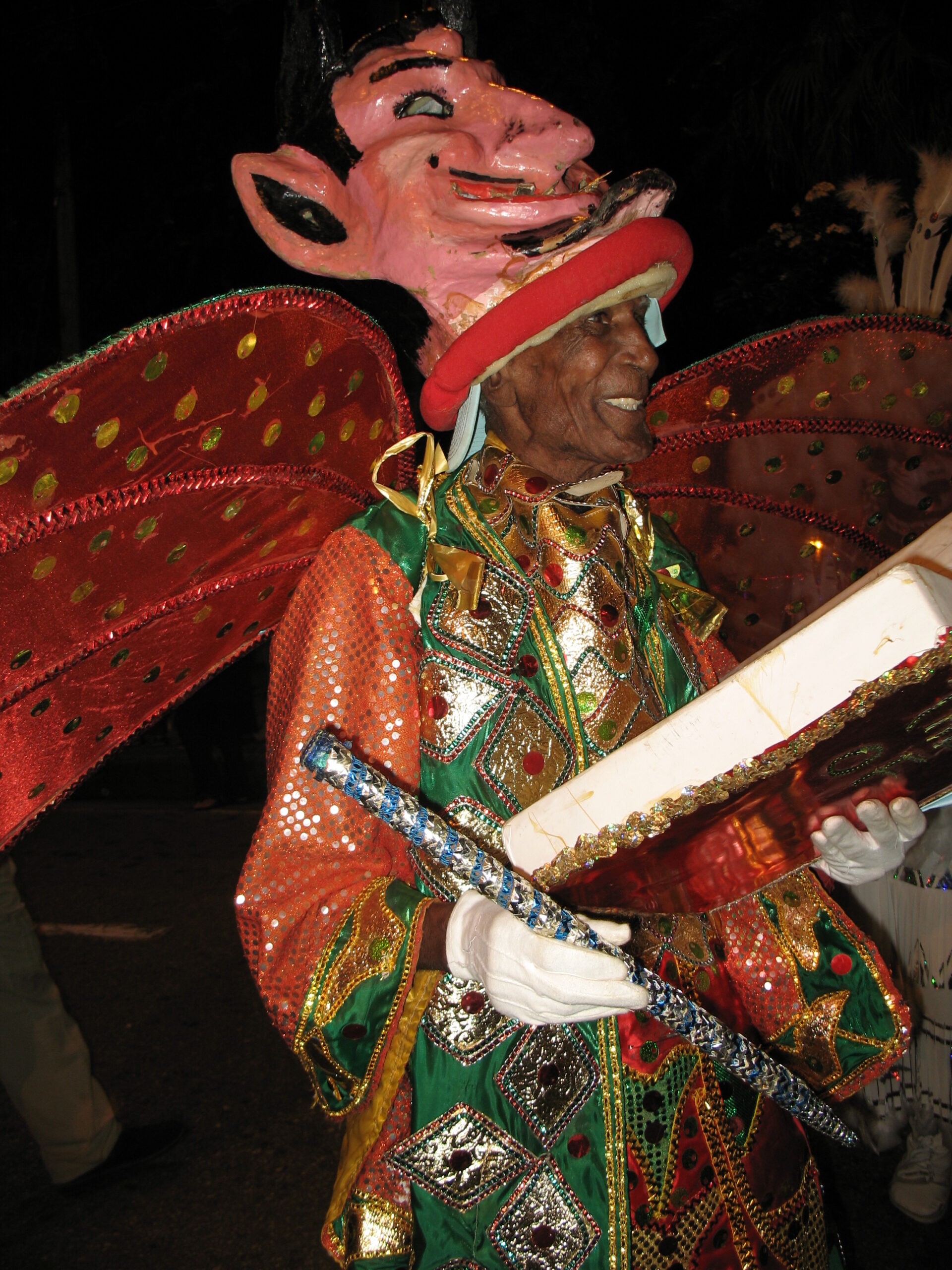
Bookman, 2017
One of the pre-eminent cultural critics of my generation in the West Indies, the late Gordon Rohlehr, towards the end of his prolific life in letters, came to consider himself a Bookman. That is, the Carnival character who, as a member of the traditional Devil mas bands, recorded our deeds and misdeeds. Rohlehr’s second-to-last book before he joined the ancestors in 2023 was entitled Perfected Fables Now: A Bookman Signs Off On Seven Decades. At its launch he explained:
My Bookman is simply a recorder of things, a voice defying amnesia… that speaks from the border and margin of everywhere, a permanent outsider, like the wanderer or seafarer of Anglo-Saxon epic or like Derek Walcott’s living dead calypsonian Spoiler, a ghost in brown gabardine who sits high, that is, intoxicated and elevated, on the hill of Laventille, overlooking city, countryside…
Half deaf as I am, half blind, my bookman nevertheless listens to the nation’s secret whispering… He surveys the lie of the land. He hears the people’s language and feels their anguish… Bookman is even now taking down your name. See if you recognize yourself somewhere in the steadily fading margins of his chronicle.
The man who begat the Devil masquerade that in turn begat the Bookman was a calypsonian, the cultural activist and fireworks maker known as Chinee Patrick – aka Patrick Jones. Of Afro-Hakka background like myself, Chinee Patrick combined Christian iconography of St. George and the dragon with Dante’s Divine Comedy, Chinese aesthetics and African eschatology to introduce variety and elegance to Carnival’s portrayal of Hell’s pantheon with his Red Devils mas band in 1906.
Thereafter devil bands varied in size and constituents. Most contained horned, winged Imps – the older characters from the nineteenth-century Trinidad Carnival and before that from Haiti. The original devil bands were minimally clothed in mud, grease and soot. Jab jab they were called, dirty mas. Jab is Creole for French Diable (devil) or Jab molassie (devils coated in sticky molasses and soot), who are today stained in blue. Those jabs, according to Rohlehr, by the late nineteenth century symbolised Black retribution:
The very term “devil” that was being placed on the Black person, particularly the rebel, was something that the rebel embraced. So he say, “Yeah, I’m the devil, I’m gonna mash up your kingdom, I go mash up your world!
The twentieth-century Imps restrained the Beast from attacking onlookers and passersby. Every band had at least one Beast with a dragon’s head and scaly skin. Secured around its waist were extended chains held by imps to control it. The Beast or Dragon was exciting and terrifying and out of this world.
Devil or Dragon bands were the favourite for spectators for their elaborate costumes and intricate dances. Recently they inspired an omnibus Dragon Festival. “The nearest thing to dragon mas is ballet. That is our ballet,” Kendolph “Cokey” Mason once explained to me. “I played all characters in that, and you have to dance till you go back home.”
I visited Mason back in the nineties because he was one of the lead buglers in Casablanca steelband in the early days, before pan essayed melodies. I was curious about that phase of pan history – when ostinatos or vamps like Afro-Cuban montunos paved the way for the steelband movement’s melodic ambitions. But the devil was in the details, and Mason was more inclined to recount the mas he played after leaving the steelband once bugles had become redundant. He joined a Devil band, his favourite since childhood in the thirties when his stepfather used to play one of the King Tempters.
“It had horn, bell, executioner with axe, executioner with mallet,” Mason said, recounting the half-scale imps, the whole-scale imps, the wooly man who danced like a skittish mimic, the upper man whose top half was scorched from feeding the fire-breathing Beast. “The character who people refer to today as the Bookman was really Beelzebub, who carried the book and pen. His was the Book of Justice.”
Traditionally our Carnival invoked the anti-heroes of Euro-American civilisation: Red, White, Black and Wild Indians (native Americans); Midnight Robbers; Bats; Mummies. In Point Cumana, where fishermen were relocated from their Chaguaramas homes to make way for a US base in World War II, they played Gestapo. But the most iconoclastic were the assemblages of devils that functioned as instruments of divine justice.
Describing New Orleans and Haiti and wherever else diasporic West Africans held fast to their ancestral culture, Zora Neale Hurston pointed out that:
The devil is not the terror that he is in European folk-lore. He is a powerful trickster who often competes successfully with God. There is a strong suspicion that the devil is an extension of the story-makers while God is the supposedly impregnable white masters, who are nevertheless defeated by the Negroes.
The trickster was Eshu, guardian of the crossroads, divine messenger between god, humanity and the dead, the storymaker who inspired Robert Johnson and other bluesmen and is my muse. Melville Herskovits added that the African-Americans’ trickster devil was “the avenger who presides over the terrors of hell and holds the souls of the damned to their penalties.” Shadow gave it to us straight, no chaser:
If you bad, don’t die
Walk about and cry
The devil down dey
You will have to pay
Pay the devil! Pay the devil!
Thus Rohlehr’s Bookman was the Devil’s indispensable collector of evidence in a section of the (sadly now nearly extinct) Dragon bands – the Gownmen. They were so-called after their ornate robes and capes, and they waltzed delicately with the music, swaying along and bowing politely to onlookers as if to calmly say: Please allow me to introduce myself, I’m a man of wealth and taste.
Every Gownman’s head, including Bookman’s, was that of a gloating, ruddy-faced Satan. Behind his grinning white man’s visage, however, was a Black man. “All Dragon men does smile behind their mask,” said Mason, explaining that the mas became manifest through you – it possessed you – just as the Gẹ̀lẹ̀dẹ́ masks did back in Africa. “Then you know the step you making before you make it.”
Gownmen included Lucifer, Satan, Gentleman Jim, Queen Patroness (if there were women) and Beelzebub or Bookman, who brought up the rear of the band with his enormous book and oversized pen for recording everyone’s deeds good and bad, including perhaps even those of the other Gownmen.
Bookman was literally the chronicler of your life – everyone’s. He listed all your overweening ambitions and petty squabbles, your fears and failures, moments of surprising and selfless generosity, hard-worked-for achievements, unexpected loves and irrational jealousies, all of which are destined for the inevitable and unavoidable fall. Thus he chronicled everyone’s life at the end of the road so they weren’t forgotten, because in West African philosophy you only die when you are forgotten. His is a voice defying amnesia, as Rohlehr pointed out.
John Berger, as a storyteller himself, arrived at a similar appreciation of the Bookman, insofar as he likened the storyteller’s job to a Secretary of Death:
Those who read or listen to our stories see everything as through a lens. This lens is the secret of narration, and it is ground anew in every story, ground between the temporal and the timeless.
If we storytellers are Death’s Secretaries, we are so because, in our brief mortal lives, we are grinders of these lenses.
The storytelleing Bookman grinds the temporal, often petty but nevertheless heroic lives we actually live, against Life – the timeless urge of a species to soar into the future of the universe on the wings of love, desire, creativity, friendship, community, god or, as Shadow acknowledged, just Life itself in the universe:
For I believe in the stars in the dark night
I believe in the sun in the daylight
I believe in the little children, yeah Lord
I believe in life and its problems.
In the individualist, profane civilisation where the African diaspora was marooned, including my own amnesiac boom town of picaresque immigrants, Life is often mistaken for the struggle to acquire wealth, fame, sex, raw power itself, or any other means of externalising your solitude into something larger, more enduring than a fragile, ephemeral body.
Our Bookmen – storytellers, calypsonians, writers, comedians and filmmakers – observe all that’s going on to fashion their narrative arts, their songs and stories, grinding them between our temporal now-for-now goals and their timeless transcendences. Thus they smoothen and polish the lenses through which we view ourselves.
The sharpness and clarity those lenses offer our vision depend on the subtlety with which they were ground. At their best,they remove the rheum – what we call “yampee” – from our eyes that we may see the world as it is rather than how they that control us wish it to be seen. Maybe that is what inspired Boukman, the eighteenth-century Senegambian who was captured and enslaved in, first, Jamaica and then in Haiti, where he received his name from the books he read. There he became a Maroon leader and Voudoo priest and catalysed the Haitian Revolution.
The smoothness with which the Bookmen grind our lenses relies on the sensitivity with which they enfold the eternal around the ephemeral, recording everyone’s story as the Devil’s faithful secretaries, even while our lives are still being lived, because the end that will inevitably arrive is already inscribed in their every living moment, as Donric Williamson (aka Lord Funny) reflected in “Time really flies”:
Day before yesterday
Was yesterday – yesterday.
Yesterday was today – yesterday.
Today was tomorrow – yesterday.
Tomorrow, today go be yesterday
Day after tomorrow – tomorrow go be yesterday.
 Kim Johnson is a filmmaker and writer.
You can find Kim Johnson’s other articles on his Substack and on his blog Santimanitay