
|
Getting your Trinity Audio player ready...
|
Reading Time 4 mins
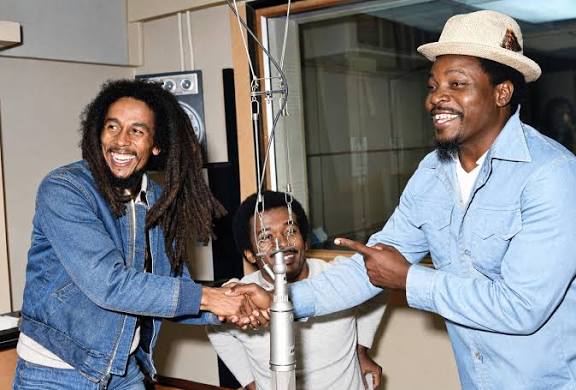
A 1979 photograph capturing a meeting between three influential Caribbean voices: Jamaican reggae legend Bob Marley, Trinidadian-born writer, storyteller and broadcaster Paul Keen Douglas, and The Mighty Sparrow (Slinger Francisco)
The September 27, 2026 transition of Slinger Francisco, better known to the world as the Mighty Sparrow, marks the passing of one of the most consequential cultural figures to emerge from the Caribbean in the twentieth century. A kaiso vocalist, songwriter and guitarist, Sparrow was born in Grand Roi, Grenada, on July 9, 1935. He would become an institution in the kaiso tradition and an unmistakable voice in the cultural and political life of the Caribbean. His death at the age of 91 invites reflection not only on the man and his music, but also on the extraordinary contribution he made to the preservation and advancement of Caribbean cultural identity.
Sparrow’s life and career are a reminder that the importance of an artist cannot be measured solely by commercial success, popularity, or the number of years spent performing. There are artists who entertain, and there are those whose work becomes part of the historical record of a people. Sparrow belonged to the latter category. Through kaiso, he documented the aspirations, contradictions, anxieties, humor, and struggles of Caribbean society. His songs were not merely compositions intended for Carnival revelry but equally important, commentaries on the human condition, the exercise of political power, social inequality, sexuality, migration, and the continuing search for dignity and self-determination among Caribbean people. The ‘Birdie’ demonstrated that the language spoken in the streets, villages, markets, the ‘blocks’, yards, and rum shops of the Caribbean was capable of expressing complex ideas about politics, morality, sexuality, economics, and the full range of human relationships.
Although born in Grenada, Sparrow’s artistic formation and rise to international prominence were closely associated with Trinidad and Tobago. It was there that he established himself as a formidable force in kaiso, beginning with the phenomenal success of Jean and Dinah in 1956. From that point onward, his career would help redefine the possibilities of the art form. He demonstrated that kaiso could be simultaneously entertaining, intellectually provocative, politically incisive, and commercially successful. His extraordinary command of language, sharp wit, and ability to expose social hypocrisy made him a formidable commentator on Caribbean life.
But what accounts for Sparrow’s enduring significance? It is, in part, his understanding that music is inseparable from the society that produces it. Kaiso emerged from a historical experience shaped by colonialism, African enslavement, resistance, and the struggle for cultural expression under oppressive social conditions. Sparrow inherited this tradition and expanded its reach. He understood that the kaisonian was more than a performer standing before an audience. The kaisonian was also a chronicler of society, a critic of political authority, and a custodian of collective memory.
It is in this context that Big Drum Nation is proud to republish a slightly edited version of a 2020 article by its founding editor, Caldwell Taylor, titled “A Birthday Tribute.” The original article commemorated Sparrow’s 66th year on the kaiso stage and celebrated his 89th birthday. Its republication is an opportunity to revisit the life and work of a Caribbean cultural giant whose contributions warrant continuing recognition and critical appreciation.
The decision to revisit this tribute is especially meaningful at a time when we are called upon to consider what it means to preserve the legacies of those who have contributed so profoundly to Caribbean civilization. Too often, the passing of a celebrated individual produces an outpouring of praise that, while deserved, is soon forgotten. The more important responsibility is to ensure that the individual’s work remains accessible to future generations and that its historical and cultural significance is properly understood.
Sparrow’s legacy demands precisely this kind of engagement. His music carried the Caribbean experience beyond the geographical boundaries of the region and challenged the assumption that artistic and intellectual excellence must originate in the metropolitan centres of Europe and North America to command international attention. He demonstrated that a man born in a small Grenadian village could become a global cultural force without surrendering the rhythms, language, sensibilities, and historical experiences that shaped his identity.
There is also a broader lesson in Sparrow’s achievement. Caribbean people have frequently been compelled to struggle for recognition of their intellectual, artistic, and cultural contributions. Yet Sparrow did not wait for external permission to establish his worth. He created, performed, competed, and asserted his place in the world through the power of his craft. His career is a testament to the proposition that cultural confidence is not bestowed by others; it is cultivated, demonstrated, and sustained through excellence.
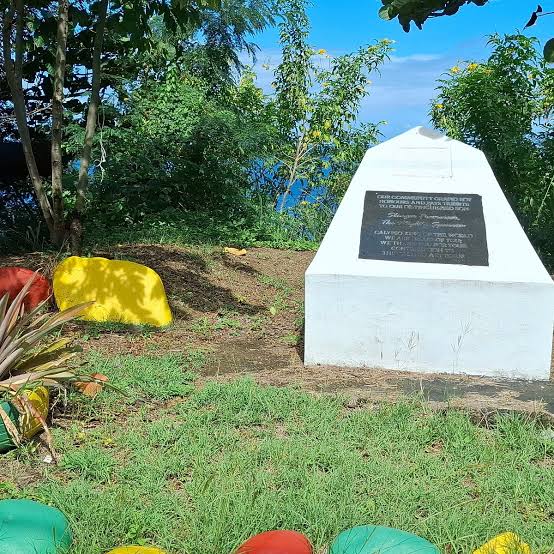
Sparrow’s monument at Grand Roy village, Grenada.
As we remember Slinger Francisco, we must therefore resist the temptation to reduce his life to nostalgia or to regard his music as merely the soundtrack of a bygone Carnival era. His body of work represents a significant cultural archive, one that offers insight into the evolution of Caribbean society and the continuing relationship between music, politics, identity, and social criticism. The preservation and study of this archive are responsibilities that extend beyond the entertainment industry to cultural institutions, educators, historians, and the Caribbean public itself.
The Mighty Sparrow has taken his final bow, but the questions his music raised have not disappeared. Neither have the social contradictions he exposed or the cultural pride he helped to cultivate. His passing should encourage us to revisit his recordings, examine his lyrics, and introduce his work to generations who may know his name without fully appreciating his contribution. Barbadian Prime Minister Mia Mottley has called for the Mighty Sparrow‘s songs, including Slave, to be included in the Caribbean Examinations Council (CXC) curriculum.
Big Drum Nation’s republication of Caldwell Taylor’s “A Birthday Tribute” is offered in this spirit of remembrance and cultural responsibility. It is an acknowledgment that the celebration of a great artist must extend beyond the occasion of a birthday or the announcement of a death. It must include a sustained commitment to preserving the work, understanding its significance, and ensuring that its lessons remain available to those who follow.
Happy Grenada-birth in memoriam, Slinger Francisco. The Great King from Grand Roi (French for “Great King”) gave the Caribbean one of its most distinguished sons, and the Caribbean gave the world the Mighty Sparrow. His voice may have fallen silent, but his music remains an enduring expression of a people’s history, imagination, and determination to define themselves on their own terms.
The Mighty Sparrow is gone from the land of the living, but his place in Caribbean cultural history is secure.